
Mental health issues have always been a common reason for patients to consult their GP, but over the last year COVID-19 has disrupted so many lives, and the number of people seeking help for their mental health has increased.
A survey by the mental health charity Mind in 2018 suggested that approximately 40% of all GP appointments now involve some element of mental health support. We knew we could do more to help, so after feedback from customers and patients we have reviewed and updated our mental health offering. We've been delighted with the positive feedback from patients about how this is helping them get the care they need.
"My husband has had increasingly poor mental health for the last two years following the death of his sister. He has accessed bereavement counselling, talking therapies and different antidepressants but his anxiety and depression have steadily worsened, to the point he has resigned from work following long periods of sick leave. He has had regular GP appointments for these two years but struggles to share the severity of his symptoms and the extent to which he is struggling to function. This is incredibly difficult for me. Recently, with his consent, I helped write an eConsult where I was able to be honest about how unwell he is and list the worst of his symptoms. His GP responded with a referral to the community mental health team for psychiatric input. This is a huge relief to us both that he will finally get the support he needs. Without eConsult, I would not have been able to share the details and use the vocabulary needed to convey the seriousness of the situation. I am incredibly grateful to have had eConsult as a tool to get my husband the help he needs."
— Jess from Liverpool
The benefits for patients and practices
From the feedback we receive, patients making mental health-related submissions mention several benefits:
- More time, while using eConsult, to think about and explain their condition or request before making it.
- The ability to put the request in writing without having to speak directly to someone, which might itself have been causing the anxiety.
- The possibility that it has saved them a trip into the practice, especially if they have anxieties around leaving the house, travelling on public transport or interacting with others.
"eConsult has literally been a lifesaver for me. I can't ring the practice as my anxiety is extreme. This service is amazing, it's an amazing tool to be resourced by your practice."
— Anonymous eConsult patient
"I very rarely leave my home because of anxiety issues. I also find it hard to explain what is going on with me because there are a lot of different problems. Sometimes on the phone I'll forget or be embarrassed to say something, so being able to write it helps me a lot."
— Anonymous eConsult patient
Self-help information and local referral services are also available through eConsult, so even if patients are not wanting to consult their practice, they can find out more about their symptoms and where to go for the most appropriate help.
"I found using eConsult very helpful to disclose anxiety and personal issues. I would have struggled to explain them at triage for an appointment and when attending an appointment where I'd have to be discussing them face to face."
— Anonymous eConsult patient
It's not just patients who benefit from having time to think about their request; this has a knock-on effect for clinicians too. With the patient's information upfront and in an easy-to-read format, they can use the eConsult report alongside the patient record to monitor changes and better understand concerns.
"The level of information that we get from having patients complete both free text and more structured questions is excellent. Where this has come to light is in mental health consultations. We've had patients really open up in terms of their personal situation, relationships, work, hobbies and exercise because eConsult specifically asks about these things. It gives them a chance to offload, and these are things that might not come up within a normal 10-minute consultation. It's giving them a chance to expand on how they're feeling."
— Dr Rizwan Hussain, Blackwood Medical Group
eConsult's mental health questionnaires
Across all eConsults submitted, around 6% of specific clinical requests come from mental health-specific questionnaires. We currently have questionnaires for anxiety, depression, low mood and panic attacks. They ask the questions usually contained in the Patient Health Questionnaire and General Anxiety Disorder questionnaires (PHQ-9 and GAD-7) as part of the information patients provide upfront.
Normally a patient would attend a face-to-face appointment to fill out these questionnaires, or be sent a paper copy. They are often used as screening tools and severity measures for generalised anxiety disorder and depression. With eConsult, the patient answers honestly, in their own time and environment, before a consultation. The results are factored into the report the practice receives and the scores are signposted for the reviewer, so the practice can take them into account when deciding on a treatment plan and response. Our 6% does not include patients who completed a general advice questionnaire instead of a condition-specific one.
Clinical review questionnaires for existing or ongoing conditions
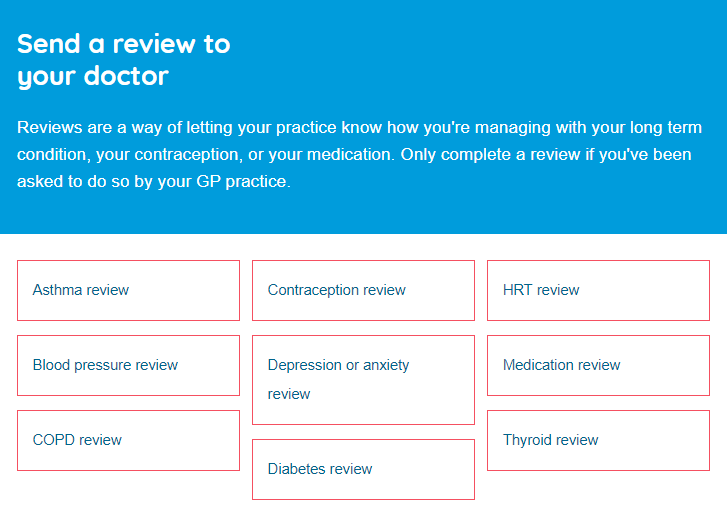
In April 2021 we launched a new depression and/or anxiety review questionnaire, designed for patients who need a routine annual mental health review or an interim review after a recent diagnosis.
This review questionnaire is more concise than the condition-specific ones. It includes all the relevant health and lifestyle data that can be included in the Quality and Outcomes Framework (QOF): a suicidal risk assessment, PHQ-9 and/or GAD-7 questions, medication compliance and side effects, and smoking and alcohol data. We anticipate it will be very popular and help GPs review and monitor their mental health patients and improve their care.
A growing list of clinical review questionnaires
Clinical review questionnaires are very useful for collecting up-to-date review information from patients with long-term conditions, or patients who need a contraceptive pill review. Sending the patient a questionnaire first may save both patient and practice time and energy. Currently we have reviews for asthma, blood pressure, COPD, the contraceptive pill, depression or anxiety, diabetes, HRT, medication and thyroid.
If you have feedback or suggestions about our mental health or review questionnaires, please get in touch.